
Why Being "Right" Is Ruining Your Relationship (And What to Do Instead)
There is a concept in Relational Life Therapy (RLT) that stops almost every client in their tracks the first time they hear it:
Objective reality has no place in relationships.

Sit with that for a second.
I know. It’s a hard one. It was for me, too. And honestly, it might be one of the most practically useful things you ever learn—not just for your relationship, but for how you move through life with the people you love.
The Truth About Being "Right"
Let’s be honest: most of us walk into disagreements with our partner with at least a low-grade desire to be validated. We want to be told, yes, you saw it correctly, your version of events is the accurate one, you win.
The problem is that relationships don't work like courtrooms. And treating them like they do is one of the fastest ways to erode connection.
In RLT, we call it an objectivity battle—when both partners dig in and assert their version of reality as the correct one. Each person is essentially saying, my perception is fact, yours is distortion. Round and round it goes. Nobody wins. Everyone loses. You go to bed that night more distant than when the argument started, even if technically one of you "won."
What makes this especially tricky is that you might actually be right. Maybe the facts do support your version. Maybe you can prove it. And it still doesn't matter—because being factually correct and being relationally effective are two completely different things. Optimizing for one often comes at the direct expense of the other.
What's Actually Happening When Your Partner Says "You Don't Show Up for Me"
Here’s a scenario I see all the time:
Your partner says, “You never show up for me.” And your brain immediately starts cataloging every single piece of evidence to the contrary. The time you rearranged your whole day. The phone call you took at midnight. The birthday you planned. The thing you did last Tuesday.
So you list it all out. You make your case. You are thorough. Possibly even a little smug about how thorough you are. And somehow, your partner is now more upset.
Sound familiar?
What just happened is that you prioritized winning the objective argument over connecting with your partner's subjective experience. And their subjective experience—how they feel, what they perceive, what they need—is the whole ballgame in a relationship. It doesn't matter if the receipts say you show up. What matters is that your partner doesn’t feel like you do.
That’s not a logic problem. That’s a relational one.
The Shift That Actually Changes Things: Compassionate Curiosity
So what’s the move instead? In RLT, we call it shifting from objectivity to relationality—and the primary tool for getting there is compassionate curiosity. Instead of building your defense, you get curious.
“I didn’t realize you were feeling that way. Can you help me understand?”
“I want to understand how you’re experiencing this.”
That’s it. That’s the shift. It sounds simple. It is not easy. There’s a reason this is something we practice in therapy and not just something you read in an article and immediately master. (No offense to articles.)
I’ll be transparent: I have had to learn this one myself, more than once. My husband used to tell me he didn't feel appreciated, and my instinct—my very thorough, well-documented instinct—was to immediately list all the ways I had been appreciating him. I had data. I had examples. I was prepared.
What I wasn't doing was listening.
The more relational response—the one I had to actually practice—sounds more like this: “I appreciate you telling me that. I want to understand why you’re feeling that way, because I feel like I have been showing you appreciation, but clearly something’s getting lost. What would help you feel more appreciated?”
Notice what that response does. It doesn’t concede that I’ve been neglectful. It doesn't throw out my own experience. But it also doesn’t turn the conversation into a debate. It moves us toward each other instead of further apart.
The Paradox: To Be Seen, You Must First See

Here is the secret that makes this "hard pill" worth swallowing: Empathy is the key that unlocks their receptivity. When you meet someone with compassionate curiosity, you aren't just "giving in." You are creating emotional safety. Once your partner feels truly understood—when they feel like you finally "get" the hurt they are carrying—their defensive walls drop.
Only then do they become capable of seeing you. By first making an effort to see their reality, you open the door for them to finally notice and value all the ways you’ve been trying all along.
Why This Is Worth It
Getting curious about your partner’s experience is not an admission of guilt. It’s an act of relational maturity. It’s saying: your inner world matters to me, and I’m interested in it, even when it’s uncomfortable to hear.
One of the core principles in RLT is that full relationship requires you to hold both your own experience and your partner's simultaneously. Not one or the other. Both.
What This Looks Like in Practice
A few questions worth sitting with—or bringing into your next session:
When my partner expresses hurt or unmet needs, what’s my first instinct? To defend, to explain, or to get curious?
Am I more invested in being right, or in being connected?
Is there a place in my relationship where I’ve been winning arguments and losing intimacy?
These aren’t comfortable questions. But discomfort is usually a sign you’re onto something worth paying attention to.
Ready to Go Deeper?
If any of this landed—if you’re reading this thinking oh, this is us—that’s actually a great sign. Awareness is the first step. The next one is doing something with it.
In my practice, I work with individuals and couples in Roseville, CA and online throughout California and Texas. I specialize in Relational Life Therapy alongside Brainspotting and Accelerated Resolution Therapy—approaches designed to get to the root of what’s driving the patterns you’re stuck in and shift them. Not in a "let's process this for five years" kind of way. In a real, meaningful, you’ll-actually-feel-different kind of way.
I offer a free 20-minute consultation if you want to figure out if working together makes sense. No pressure, no pitch—just a real conversation.
SIGN UP TO MY NEWSLETTER AND GET THE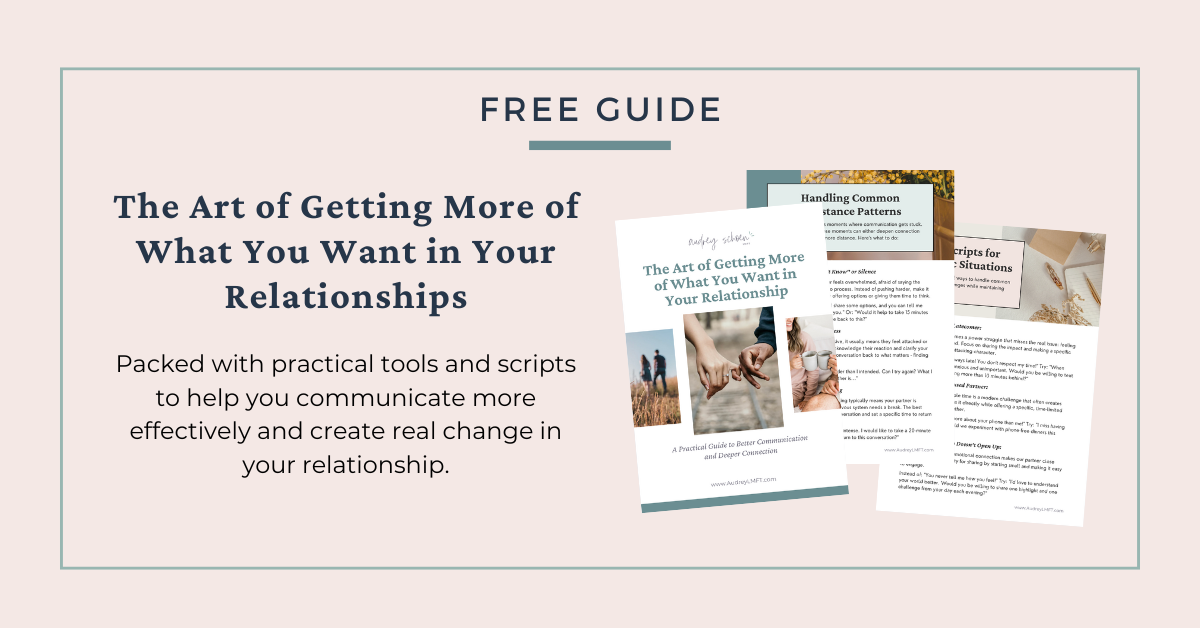
Plus, you'll get relationship tips, book & podcast recommendations, occasional updates, and more.
You can expect to receive about 1-4 emails per month.❤️