
What Is Relational Mindfulness? (And Why It’s the Only Place to Start)
Most people come into therapy, or pick up a relationship book, or fire up a podcast, looking for better communication skills. A script for the hard conversation. A technique for de-escalating the fight they keep having.
And those things have their place. I teach them. I use them. They work.
But almost every time, we get there too fast.
Because before any skill works, before the feedback wheel or the repair conversation or the boundary you’ve been trying to set for two years, you need something more foundational. Something that determines whether you can actually access those skills when it matters.
That something is relational mindfulness.

What Relational Mindfulness Actually Is
Let’s start with what it isn’t. It’s not sitting cross-legged on a meditation cushion (though that can help). It’s not being calm all the time. It’s not achieving some elevated emotional state where you float above conflict, serene and untouchable.
Relational mindfulness, as Terry Real defines it in Relational Life Therapy, is the practice of staying connected to the part of you that wants to be in relationship. Of paying attention, on purpose, to what’s happening inside you in real time, especially during the moments when another part of you wants to shut down, lash out, or win.
Real puts it plainly: relational mindfulness is a minute-by-minute practice. Not a state you achieve and maintain. A practice you return to, again and again, in the middle of real life.
It means the bar isn’t perfection. It’s attention.
It’s Not What You Do. It’s Who You’re Being.
Here’s the reframe that changes everything: relational mindfulness isn’t primarily about what you do in your relationship. It’s about who you are being.
We put a lot of energy into doing. Saying the right thing. Using the right tone. Applying the right tool at the right moment. And I’m not saying none of that matters. It does. But all of it is downstream of a more fundamental question: who is actually showing up right now?
Your partner doesn’t experience your intentions. They experience your presence and the quality of it. The warmth or the distance. The openness or the defense. The person who’s trying to win versus the person who actually wants to connect.
Skills are what the wise adult does when they’re present. But the skill isn’t the point. The being is the point.
This is why you can know exactly what you’re supposed to do, and still not do it. Not because you’re failing. Because the part of you running the show in that moment isn’t the part that knows.
The Three Components: Awareness, Containment, Presence
In Relational Life Therapy, the goal of relational mindfulness is described in terms of three things working together. I think of them as a sequence:
Awareness. Noticing your adaptive child (your reactive self) as it’s happening. Catching the whoosh before it makes the decisions. This is where everything starts. You can’t work with what you can’t see.
Containment. Developing the capacity to hold that reactive part without acting from it. Not suppressing it. Not shaming it. Containing it the way a good parent holds a distressed child without becoming the distressed child themselves.
Wise adult presence. Operating from the grounded, values-led part of you that can actually choose how to respond. This is the goal state. Not a performance of calm. A genuine return to yourself.
Most of the work in this series are about supporting that sequence. But the sequence itself is the practice. And it starts before any specific technique gets deployed.
The Moment Everything Goes Sideways
You know the moment. Your partner says something. Maybe it’s a tone. Maybe it’s a particular word they always use. Maybe it’s a look you’ve seen a thousand times and it never gets less loaded.
And then, before you’ve even registered what happened, you’re somewhere else entirely. You’re defending yourself. You’re shutting down. You’re saying something you’ll regret, or you’re going very quiet in a way that communicates everything.
In Relational Life Therapy, this is sometimes called “the whoosh.” That automatic nervous system response that happens faster than conscious thought. Your brain interprets a cue, a tone, a facial expression, a pattern it’s recognized before, and your body responds as if there’s a threat. Defenses go up. The rational, caring, we’ve-talked-about-this-in-therapy part of you goes offline. And something older and more defended takes the wheel.
The whoosh doesn’t make you a bad partner. It makes you human. Your nervous system is doing exactly what it was designed to do. Protect you.
The problem is that it’s usually working from old data.
Why Old Data Is Running Your Relationship
Here’s what nobody tells you about the patterns that derail your relationships: they didn’t start in your relationship. They started much earlier.
In Relational Life Therapy, we work with what’s called the adaptive child, which is the part of you that developed strategies to cope with (and sometimes survive) your early experiences. If you grew up in a house where conflict meant someone getting hurt, your nervous system learned to go small or go away when tensions rose. If love was conditional, you may have learned to perform rather than be seen. If being vulnerable got you dismissed, you may have learned to lead with competence instead of emotion.
These adaptations were smart. They were even necessary. And your nervous system doesn’t know that the rules have changed.
So when something happens in your relationship that even faintly echoes those old dynamics (the same vague threat of rejection, or conflict, or criticism) your adaptive child responds with the same old strategies. Strategies that were built for a different time, a different relationship, a different version of you.
This is not a character flaw. It is not proof that you’re bad at relationships. It’s the nervous system doing its job, just not a job that serves you anymore.
Relational mindfulness is what creates the pause between the trigger and the response. That pause is where everything can change.
The Gap Between Knowing and Doing
Here’s something I hear constantly in my practice, and I want to name it directly because it matters:
“I know what I’m supposed to do. I just can’t do it in the moment.”
This is one of the most honest and frustrating things about relationship work. You can read every book, learn every framework, practice every script and still find yourself, in the heat of the moment, doing the exact thing you promised yourself you wouldn’t do.
That gap between knowing and doing is not a skills problem. It’s a nervous system problem. When the adaptive child takes the wheel, your access to all those carefully learned skills narrows dramatically. You’re not being intentional. You’re surviving.
This is also why I use approaches like Brainspotting and Accelerated Resolution Therapy alongside Relational Life Therapy. Some patterns are stored at a level that talking alone doesn’t reach. The nervous system needs its own kind of attention. When we address the root of the reactivity, the skills you’ve been trying to use actually start to land.
But the starting place is still the same: awareness. The practice begins with noticing what’s happening in your body, and in the room, before you act on it.

Caring for the Space Between You
There’s one more dimension to relational mindfulness that I want to name, because it’s easy to miss.
Most of the time when we think about relationship work, we think about ourselves. Managing our reactions. Changing our patterns. Getting better at the skills. And that’s all real and necessary work.
But relational mindfulness is also about the space between two people, what we call “the relational environment.” What is the quality of what’s being created between you? What does it feel like to be in relationship with you? Not in the abstract, but in this moment. In this conversation. In the way you walked into the room.
Every moment in a relationship is moving it somewhere. That’s worth sitting with.
A useful question to carry with you: this thing I’m doing right now… this tone, this withdrawal, this comment, this repair attempt… What is it moving us toward? Toward closeness or away from it. Toward safety or toward threat. Most of us aren’t asking the question. Relational mindfulness is what makes it possible to ask it in real time.
What the Practice Actually Looks Like
If relational mindfulness is a minute-by-minute practice, what does it look like in actual minutes?
A body scan. Your body usually signals the whoosh before your brain catches up. Learn the physical signature of your own activation — tightening chest, shoulders rising, a shift in breathing. Your body is your early warning system.
The one-breath pause. Just one. Between what happened and what you do next. That’s not a long time. It’s often enough.
Cultivating curiosity. Instead of moving straight into reaction, ask: what is actually happening in me right now? Is this about right now, or am I importing something from somewhere else?
The orienting question. “What is this moving us toward?” In any relational moment, this question can help the wise adult orient before the adaptive child acts.
Mantras and anchors. A short phrase that reconnects you to what you actually want. I want to be close to this person. I want to respond from the person I’m trying to be.
A daily mindfulness practice. The skill of noticing is trainable. You build it off the field so you have access to it on the field.
None of this is about performing calm. You are allowed to be upset. Relational mindfulness is not about suppressing the emotional response, it’s about choosing what you do with it. About who you are being, even when it’s hard.
A Note for High Achievers (This One’s for You)
If you’ve built something significant — a business, a career, a life that required you to be relentlessly competent and effective — there’s a particular way relational mindfulness can be difficult.
You’re very good at solving problems. You assess quickly, identify the issue, and move toward resolution. That skill set, applied in relationships, often looks like needing to be right. Moving too fast to the fix. Talking over the emotional moment in pursuit of resolution.
The other thing that happens with high performers: you’ve often succeeded by being pretty well defended. The walls that kept you focused and high-output are the same walls that keep you from being fully present with the people closest to you.
The hard truth is that your partner feels the distance. Even when you’re technically doing everything right. Because doing the right things from behind a wall is not the same as being present. And the people who love you know the difference.
Relational mindfulness asks you to slow down in exactly the places your instincts tell you to speed up. To stay with discomfort instead of solving it. To ask “what is this moving us toward” instead of “how do I close this out.”
That’s hard. I know. I’ve had to do this work myself. It’s also one of the most important things you’ll do.
Why This Is the Foundation of Everything
Over the course of this series, we’re going to cover a lot of ground: the adaptive child, the wise adult, the five losing strategies, repair, intimacy, commitment, the relational patterns that keep couples stuck. All of it is worth covering.
But all of it rests on this.
If you can’t slow down enough to notice what’s happening inside you before you act — if the whoosh keeps running the show — none of the skills will land when you need them. You’ll use them when you’re calm and lose them when you’re triggered.
Relational mindfulness doesn’t eliminate reactivity. Nothing does. But it widens the space between stimulus and response. It brings you back to yourself. It keeps the question alive: who am I being right now? And what is this moving us toward?
Terry Real puts it this way: you must live in relational mindfulness. Not visit it. Not deploy it strategically. Live in it. As a practice, a commitment, a daily orientation toward the person you’re in relationship with.
That’s a high bar. It’s also a generous reframe. Every moment is an opportunity to practice. Not just the moments you get right, the ones you don’t are practice too.
What This Looks Like in My Practice
When clients come to work with me, whether that’s individuals, couples, or entrepreneurs navigating both personal and relational challenges, we don’t start with skill-building in a vacuum. We start with understanding what you’re bringing into the room. Your history. Your patterns. The ways your nervous system has adapted over the years and what those adaptations cost you now.
I draw from Relational Life Therapy, Brainspotting, and Accelerated Resolution Therapy depending on what the work calls for. My sessions are in-person in Roseville, CA and online throughout California and Texas.
If you’re curious about what working together could look like, reach out.
The Practice Starts Now
You don’t have to wait until you’re in a therapist’s office. You can start this week, in the next conversation that gets tense, in the next moment when you feel the whoosh coming on.
You don’t have to catch it every time. You just have to be paying attention.
And when you’re not sure what to do, when you’re activated and the adaptive child is right there at the surface, come back to the question:
This thing I’m doing right now. What is it moving us toward?
That’s the practice. Week by week, we’ll build the relational muscle together.
Welcome to Week 1.
Audrey Schoen is a Licensed Marriage and Family Therapist in Roseville, CA, specializing in couples, individuals, and entrepreneurs. She practices Relational Life Therapy, Brainspotting, and Accelerated Resolution Therapy, and offers in-person sessions in the Sacramento area and online throughout California and Texas.
RLT concepts in this post are drawn from Terry Real’s Relational Life Therapy framework, including The New Rules of Marriage (2007) and Us (2022).
SIGN UP TO MY NEWSLETTER AND GET THE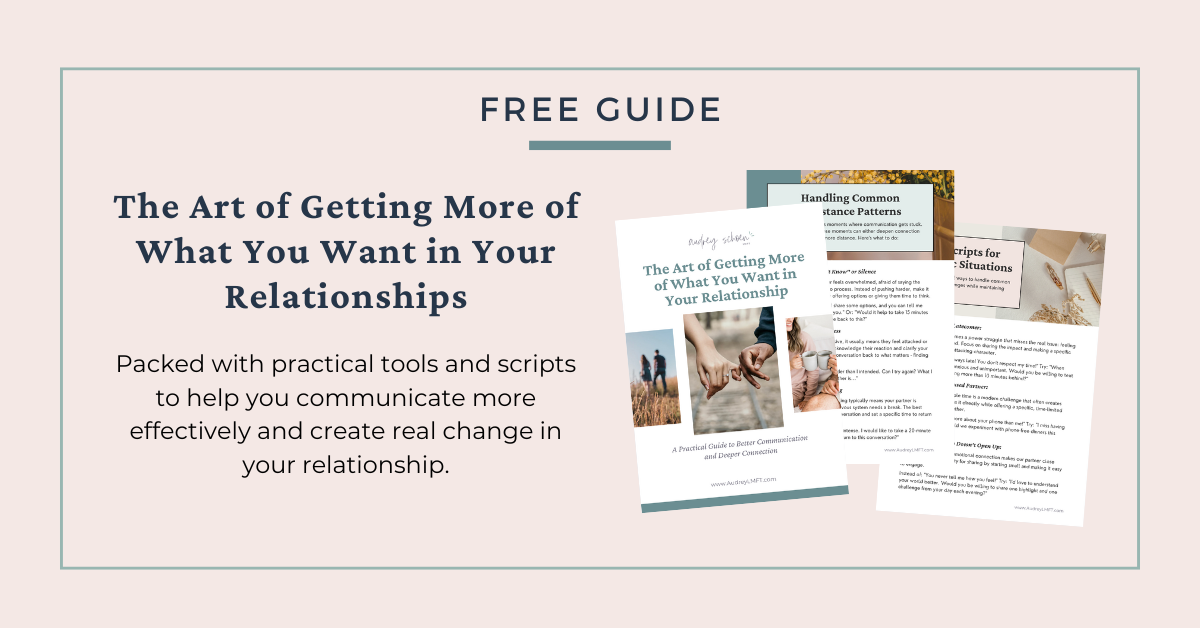
Plus, you'll get relationship tips, book & podcast recommendations, occasional updates, and more.
You can expect to receive about 1-4 emails per month.❤️